
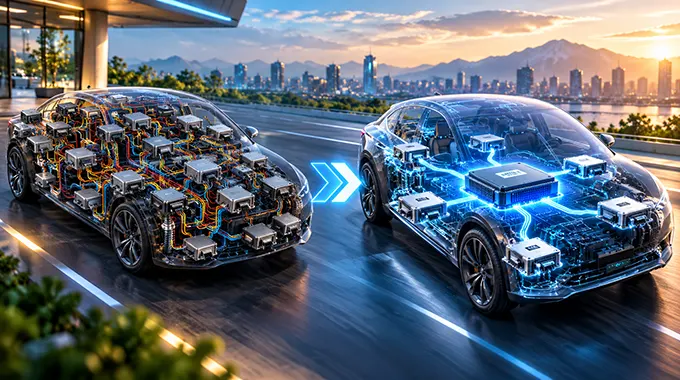
The automotive industry is undergoing a major transformation as manufacturers move toward software-defined vehicles (SDVs). Traditional vehicles rely on numerous electronic control units (ECUs), each designed to manage specific functions such as braking, lighting, engine performance, climate control, or infotainment. Although this decentralized architecture has supported automotive innovation for decades, growing software complexity and connectivity requirements are driving a shift toward centralized computing platforms.
Central electronic control units are becoming a key foundation of software-defined vehicles, enabling manufacturers to consolidate computing resources, simplify vehicle electronics, and deliver new features through over-the-air (OTA) software updates. Combined with domain controllers and zonal computing architectures, this approach changes how automotive software is developed, deployed, and maintained. <Cite refs={[“turn731463search0″,”turn731463search10”]}/>
Understanding Decentralized Automotive ECU Architecture
In a traditional decentralized architecture, individual ECUs operate dedicated vehicle functions. A body control module may manage interior lighting, while separate controllers handle powertrain operations, braking assistance, and other systems.
This arrangement offers functional separation, but the increasing number of controllers creates integration challenges. Each additional ECU can introduce hardware costs, wiring requirements, communication dependencies, and software maintenance responsibilities.
As vehicles incorporate advanced driver-assistance systems (ADAS), connected services, and increasingly sophisticated infotainment, managing numerous independent controllers becomes more difficult. Software updates may require coordination across multiple modules, while adding new features can involve substantial hardware and integration work. <Cite refs={[“turn731463search2″,”turn731463search5”]}/>
How Central ECUs Transform Vehicle Computing
Centralized automotive computing consolidates selected functions onto a smaller number of powerful electronic control platforms. Instead of assigning every feature its own dedicated controller, manufacturers can execute multiple software applications on shared computing hardware.
These platforms, often called central compute units or high-performance computers (HPCs), provide greater processing capacity for complex workloads, including sensor fusion, connected services, and cross-domain vehicle functions.
Software can also be separated more effectively from the underlying hardware through abstraction layers, standardized interfaces, and virtualization. This separation allows development teams to update or introduce supported software functions without redesigning an entire collection of dedicated ECUs.
However, centralization does not mean every ECU disappears. Safety-critical functions, specialized actuators, and sensors may still require local controllers to meet real-time, reliability, and functional-safety requirements. <Cite refs={[“turn731463search8″,”turn731463search26”]}/>
The Role of Modern Vehicle Domain Controllers
Domain controllers represent an important transition between decentralized ECUs and more centralized vehicle architectures. They consolidate multiple related functions within a specific area of responsibility.
Common examples include:
- Powertrain domain controllers: Coordinate selected propulsion and powertrain functions.
- ADAS domain controllers: Process data from cameras, radar, and other sensors to support driver-assistance features.
- Body and comfort controllers: Coordinate functions such as lighting, access, windows, and climate-related systems.
- Infotainment controllers: Manage multimedia, navigation, connectivity, and digital user experiences.
By consolidating related functions, domain controllers can reduce the number of independent modules and simplify software integration. They also provide a practical migration path for manufacturers that cannot immediately replace an established vehicle architecture.
Over time, selected domain functions can move to centralized computing platforms, provided performance, safety, and compatibility requirements are satisfied. <Cite refs={[“turn731463search2″,”turn731463search5”]}/>
Why Zonal Computing Architecture Matters
Zonal architecture organizes vehicle electronics according to physical location rather than exclusively by functional domain. For example, a vehicle may use separate zone control units for its front, rear, left, and right areas.
Each zone controller connects nearby sensors, actuators, and electrical components to the vehicle’s communication backbone. A central compute platform can then manage higher-level software functions across multiple zones.
This architecture offers several advantages:
- Simplified wiring: Shorter local connections can reduce wiring harness complexity.
- Flexible integration: Regional controllers provide consistent interfaces for vehicle components.
- Improved scalability: Manufacturers can adapt computing resources to different vehicle platforms.
- Better software distribution: Centralized management can simplify the coordination of software across supported modules.
Zonal computing therefore complements central ECUs rather than simply replacing every distributed controller. Local hardware continues to handle physical inputs and outputs, while central platforms execute broader software workloads. <Cite refs={[“turn731463search1″,”turn731463search25”]}/>
Over-the-Air Firmware Updates in Software-Defined Vehicles
OTA updates are among the most important benefits of software-defined vehicle architecture. Instead of requiring a workshop visit for every supported software improvement, manufacturers can distribute software packages remotely to compatible vehicle systems.
Centralized computing can simplify update coordination by providing a more unified platform for software deployment. When combined with zonal controllers and appropriate vehicle networking, it can also help manufacturers manage updates across different electronic modules.
A robust OTA system typically requires several safeguards:
- Cryptographically verified software packages.
- Secure communication and device authentication.
- Compatibility checks before installation.
- Reliable installation and recovery mechanisms.
- Post-update validation and fault monitoring.
Updates must also account for vehicle operating conditions and functional-safety requirements. Critical software should not be installed in a way that compromises braking, steering, propulsion, or other essential functions. Centralization can improve update management, but it does not eliminate the need for rigorous testing and secure software lifecycle processes. <Cite refs={[“turn731463search0″,”turn731463search26”]}/>
Challenges of Centralized Automotive Electronics
Despite its advantages, centralization introduces important engineering challenges. Concentrating more functions on fewer computers increases the consequences of hardware failures, software defects, and cybersecurity incidents.
Manufacturers must carefully manage processing capacity, thermal performance, network latency, and isolation between applications with different safety requirements. Legacy vehicle components can also make integration more difficult because existing systems may use different communication protocols and software interfaces.
Functional safety, cybersecurity, redundancy, and fault containment must therefore remain central design priorities. A gradual transition through domain controllers and zonal computing can help manufacturers manage these risks while preserving compatibility with established systems.
Central Electronic Control Unit
Central electronic control units are reshaping automotive electronics by consolidating computing resources and separating software development from dedicated hardware wherever practical. Domain controllers provide an intermediate step, while zonal architectures organize local connections around a centralized computing platform.
Together, these technologies support more scalable software-defined vehicles and create a stronger foundation for OTA updates, connected features, and future vehicle capabilities. Success ultimately depends on balancing computing consolidation with real-time performance, functional safety, cybersecurity, and reliable integration.
As automotive platforms continue to evolve, centralized and zonal computing will play an increasingly important role in making vehicle software easier to develop, maintain, and improve throughout the vehicle lifecycle.