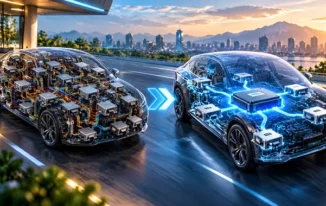

Modern vehicles rely on sophisticated electronic control units (ECUs) to manage everything from engine performance and braking systems to battery management and advanced driver assistance. Before these systems enter production, engineers must ensure that their hardware and embedded software can respond reliably under a wide range of operating conditions. Traditional vehicle testing alone can be expensive, time-consuming, and difficult to reproduce.
Hardware-in-the-Loop (HIL) simulation offers a practical solution. It allows engineers to connect real automotive control hardware to a simulated vehicle environment, creating a controlled testing setup that reproduces real-world signals and operating conditions. Through automated testing, digital twin validation, and stress simulation, HIL helps identify design problems earlier in the development process.
Understanding Hardware-in-the-Loop Simulation
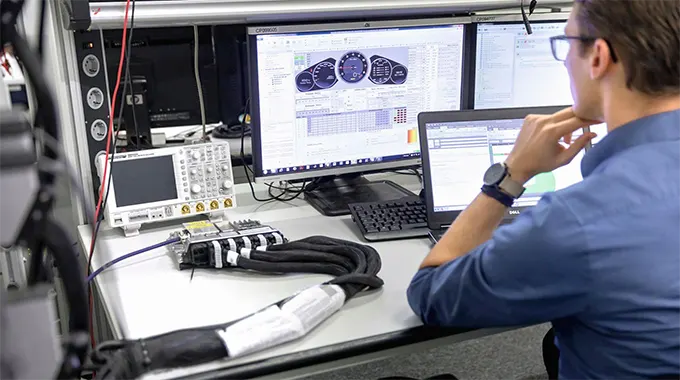
Hardware-in-the-Loop simulation is a testing methodology that combines physical electronic hardware with a real-time computer simulation. Instead of installing an ECU in a complete vehicle, engineers connect it to a simulator that generates the electrical signals and operating conditions the control unit would normally receive.
For example, an engine control unit can be tested using simulated engine speed, temperature, throttle position, and sensor feedback. The ECU processes these inputs and sends control signals back to the simulator. The system evaluates whether its responses match the expected behavior.
This approach makes it possible to test complex automotive hardware without requiring a physical vehicle for every experiment. It also allows engineers to reproduce unusual operating conditions that might be difficult or unsafe to create on a road or test track.
Automated Testing Strategies for Automotive Control Units
One of the biggest advantages of HIL technology is its ability to support repeatable automated testing. Engineers can develop test sequences that evaluate ECU performance across thousands of scenarios with consistent inputs and measurable results.
Automated testing strategies commonly include:
- Functional testing: Verifies whether control units perform their intended functions under normal operating conditions.
- Boundary testing: Checks how hardware responds when sensor values, voltage levels, temperatures, or operating parameters approach their specified limits.
- Fault-injection testing: Introduces simulated sensor failures, communication interruptions, short circuits, and other faults to evaluate diagnostic and recovery behavior.
- Regression testing: Repeats previously completed test cases after hardware or software modifications to identify unexpected changes.
- Stress testing: Exposes control units to demanding combinations of operating conditions to evaluate reliability and performance.
By automating these processes, development teams can reduce repetitive manual work and detect potential problems before expensive production stages.
Digital Twin Validation in Automotive Engineering
Digital twin technology provides another important capability for modern HIL testing. A digital twin is a virtual representation of a physical system that can reproduce selected behaviors and operating characteristics.
In automotive engineering, digital models can represent vehicle dynamics, electric powertrains, battery systems, braking mechanisms, and sensor environments. When integrated with HIL hardware, these models allow engineers to compare the behavior of real control units against expected simulation results.
For example, an electric vehicle battery management system can be connected to a simulated battery model. Engineers can evaluate how the controller responds to changing cell voltages, charging conditions, temperature variations, and simulated battery faults.
Digital twin validation is particularly valuable during prototyping because it helps teams investigate design assumptions before committing to expensive physical components. However, simulation accuracy depends on model quality, calibration, and validation against reliable physical measurements.
Real-Time Simulation and Hardware Integration
Successful HIL testing requires a real-time simulation platform capable of exchanging signals with physical automotive hardware at predictable intervals. Timing accuracy is essential because many vehicle control systems operate within strict response windows.
The test environment may include real-time processors, signal conditioning equipment, analog and digital input/output interfaces, communication networks, and specialized ECU connectors.
Automotive communication protocols such as CAN, LIN, FlexRay, and Automotive Ethernet can be incorporated depending on the system being tested. These interfaces allow engineers to examine communication behavior, message timing, and network-related faults.
Careful integration is necessary to ensure that simulated signals accurately represent the electrical and communication conditions expected in an actual vehicle.
Automated Stress Testing and Fault Detection
Automotive control units must operate reliably despite temperature changes, electrical disturbances, sensor faults, and communication problems. HIL platforms allow engineers to reproduce these conditions systematically.
A test campaign might combine low supply voltage, fluctuating sensor readings, network delays, and high simulated operating loads. Automated monitoring then records ECU outputs, response times, diagnostic messages, and unexpected behavior.
These results help engineering teams identify weaknesses in hardware design, embedded software, and system integration. Test reports can also provide traceable evidence of which scenarios were executed and whether the expected outcomes were achieved.
HIL testing does not replace environmental qualification, electromagnetic compatibility testing, or physical durability testing. Instead, it complements these methods by offering repeatable functional and integration testing under controlled conditions.
Benefits for Automotive Product Development
Integrating HIL simulation into the development lifecycle provides several advantages:
- Earlier defect detection: Engineers can identify control-system problems before vehicle prototypes reach advanced development stages.
- Lower testing costs: Many scenarios can be evaluated without using complete vehicles or expensive road tests.
- Improved repeatability: Automated test sequences make it easier to reproduce faults and compare results.
- Faster development cycles: Continuous testing helps teams evaluate hardware and software changes more efficiently.
- Greater engineering confidence: Systematic validation provides stronger evidence that automotive control units meet their technical requirements.
These benefits become increasingly important as vehicles adopt more interconnected electronic systems and software-defined architectures.
Automotive Hardware-in-the-Loop Simulation is an important computer engineering methodology for validating electronic control units before production. By combining real hardware, real-time simulation, digital twin models, and automated stress testing, engineers can evaluate complex automotive systems in a controlled environment. Although HIL cannot replace every form of physical vehicle testing, it provides an effective way to improve test coverage, identify faults earlier, and strengthen development quality. As automotive electronics become more advanced, HIL simulation will remain an essential part of