
Autonomous vehicles must understand their surroundings continuously and make driving decisions within fractions of a second. They need to detect pedestrians, recognize traffic signs, estimate the distance to nearby vehicles, and identify potential hazards while moving through changing environments. Achieving this requires more than advanced sensors. It also demands powerful computing systems capable of processing large amounts of information with extremely low latency.
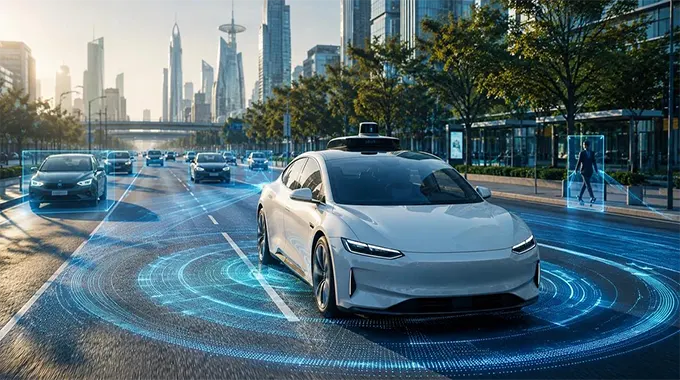
Real-Time Edge AI makes this possible by bringing artificial intelligence processing directly onto the vehicle. Combined with sensor fusion algorithms, it allows autonomous driving systems to interpret data from LiDAR, radar, and cameras without depending on constant communication with remote cloud servers. This combination is becoming an essential foundation for safer and more responsive autonomous navigation.
Understanding Real-Time Edge AI in Autonomous Vehicles
Edge AI refers to artificial intelligence processing performed close to where data is generated. In autonomous vehicles, this usually means dedicated onboard computing units that process sensor information locally.
Unlike cloud-based processing, edge computing reduces the need to transmit large sensor datasets over wireless networks. This is particularly important because autonomous vehicles must respond immediately to unexpected situations, such as a pedestrian entering the road or another vehicle suddenly changing lanes.
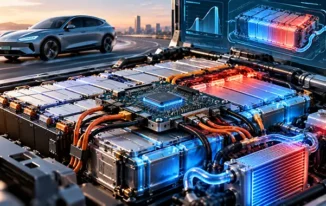
Automotive edge AI platforms commonly use specialized processors, including GPUs, AI accelerators, and system-on-chip architectures. These components support neural network inference, object detection, image processing, and environmental understanding.
By processing information locally, autonomous systems can reduce communication delays and maintain important perception functions even when network connectivity is unavailable.
Integrating LiDAR, Radar, and Camera Sensors
Reliable autonomous perception depends on combining different sensor technologies. Each provides a distinct view of the surrounding environment.
LiDAR sensors use laser pulses to measure distances and generate three-dimensional point clouds. They provide detailed spatial information that helps vehicles identify road boundaries, obstacles, and the positions of surrounding objects.
Radar sensors use radio waves to estimate the distance and relative speed of nearby objects. They can perform effectively in conditions such as darkness, rain, and fog, although their spatial detail may differ from that of LiDAR and cameras.
Camera systems capture visual information, allowing AI models to recognize traffic lights, road markings, signs, pedestrians, and other objects based on appearance and context.
Individually, these sensors have limitations. Together, they provide complementary information that can improve environmental awareness. However, their outputs must be synchronized, calibrated, and interpreted correctly before they can support reliable driving decisions.
Embedded Sensor Fusion Algorithms
Sensor fusion is the process of combining information from multiple sensors to create a more complete representation of the vehicle’s surroundings. Embedded sensor fusion algorithms perform this task within the vehicle’s onboard computing environment.
Two common approaches are early fusion and late fusion. Early fusion combines sensor data or extracted features before the main perception model produces its final detections. Late fusion combines the results generated independently by different sensor-processing systems.
Engineers may also use probabilistic methods, such as Kalman filters and Bayesian estimation, to track objects and estimate their positions over time. More advanced systems combine deep learning with geometric and statistical techniques to interpret complex scenes.
For real-time edge computing, algorithm efficiency is critical. Models must balance accuracy with processing speed, memory consumption, and power requirements. Sensor fusion pipelines therefore need to be optimized for the specific hardware platform and vehicle operating conditions.
Low-Latency Onboard AI Processing
Autonomous perception systems process substantial amounts of data. High-resolution cameras generate continuous image streams, while LiDAR sensors produce large point-cloud datasets and radar systems provide frequent object measurements.
Onboard AI processors must handle these workloads while maintaining predictable response times. Techniques such as model quantization, pruning, optimized neural network architectures, and parallel processing can reduce computational demands.
Engineers also use real-time operating systems and carefully designed software pipelines to manage task scheduling, memory access, and communication between processing units.
Latency must be evaluated across the complete perception pipeline, from sensor capture and synchronization to object detection, tracking, and output generation. A fast neural network alone does not guarantee a fast autonomous system.
Challenges in Autonomous Perception
Despite its advantages, integrating edge AI and sensor fusion presents several engineering challenges.
Sensor calibration is essential because even small alignment errors can cause information from different sensors to disagree. Environmental conditions can also affect sensor performance, particularly when cameras encounter glare, darkness, or heavy rain.
Computational limitations create another challenge. Vehicle systems must operate within strict power and thermal budgets while processing complex AI workloads. Engineers must therefore optimize software and hardware together.
Safety validation is equally important. Perception systems must be tested across diverse scenarios, including unusual obstacles, partial sensor failures, changing road conditions, and unexpected interactions with other road users.
The Future of Edge AI in Autonomous Driving
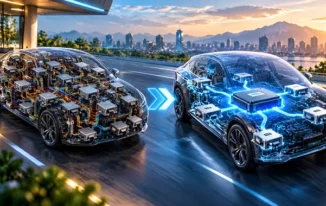
Future autonomous vehicles will increasingly depend on integrated computing platforms that combine perception, sensor fusion, and decision-support functions. Advances in AI accelerators, automotive system-on-chip designs, and efficient neural networks will help improve onboard processing capabilities.
The development of more sophisticated sensor fusion algorithms may also support better object tracking, improved environmental interpretation, and more consistent perception in complex traffic conditions.
However, autonomous driving safety will continue to depend on comprehensive system engineering, including redundancy, cybersecurity, functional safety, and extensive real-world validation.
Real-Time Edge AI and autonomous perception systems are transforming how self-driving vehicles understand and respond to their surroundings. By integrating LiDAR, radar, and camera hardware with efficient onboard AI processing, automotive engineers can develop perception systems that operate with reduced dependence on cloud connectivity.
Embedded sensor fusion algorithms are central to this progress. Their ability to combine complementary sensor information while meeting strict latency and computational requirements makes them an important part of modern autonomous vehicle architecture.
As automotive hardware and AI technologies advance, edge-based perception will remain a critical area of research and development for intelligent mobility.