
Artificial intelligence is becoming part of everyday life. From chatbots and image generators to recommendation systems and business automation, AI tools can perform tasks that once required significant human effort. But behind every intelligent response is a powerful computing infrastructure designed to process enormous amounts of data.
One important part of this infrastructure is the AI server. Unlike traditional servers built mainly to manage websites, databases, and business applications, AI servers are designed to handle demanding workloads such as training machine learning models and generating AI responses.
Understanding what an AI server is helps explain why modern artificial intelligence depends not only on sophisticated software but also on specialized hardware.
What Is an AI Server?
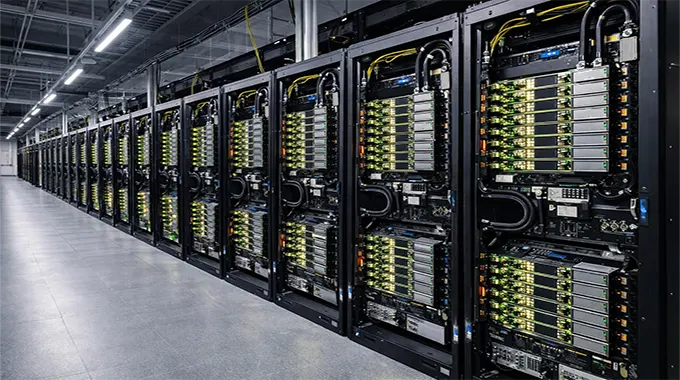
An AI server is a computer system specifically designed to run artificial intelligence workloads. It combines powerful processors, high-speed memory, storage systems, and networking components to support tasks such as machine learning, deep learning, natural language processing, and image recognition.
Think of a traditional server as an office administrator handling many different requests. It manages files, processes transactions, runs applications, and responds to users. An AI server, on the other hand, resembles a specialized research laboratory equipped to perform complex calculations at enormous speed.
AI servers are commonly used for two major activities: model training and inference. Training involves teaching an AI model to recognize patterns using large datasets. Inference happens when a trained model uses what it has learned to generate an answer, classify an image, or make a prediction.
Traditional Servers vs. AI Servers
Traditional general-purpose servers typically rely heavily on Central Processing Units (CPUs). A CPU is designed to handle a wide variety of computing tasks efficiently. It excels at executing sequential instructions, managing operating systems, processing database operations, and coordinating applications.
AI servers often include Graphics Processing Units (GPUs) or specialized AI accelerators called Neural Processing Units (NPUs). These processors are designed to perform large numbers of mathematical operations simultaneously.
The difference is similar to comparing a small team of highly versatile workers with a large group of specialists. A CPU can handle different tasks flexibly, while a GPU can perform thousands of similar calculations in parallel.
Both types of servers remain important. AI infrastructure still needs CPUs for general system management, data preparation, and coordination. GPUs and other accelerators provide the computational power required by many demanding AI workloads.
Why GPUs Are Essential for Artificial Intelligence
Modern AI models depend heavily on mathematical operations involving large arrays of numbers, known as tensors. Neural networks repeatedly perform operations such as matrix multiplication to process information, identify patterns, and generate predictions.
GPUs were originally developed to render graphics by processing many pixels and mathematical operations simultaneously. This parallel-processing architecture also makes them highly effective for deep learning workloads.
Imagine a factory receiving thousands of identical packages that need sorting. One worker handling every package individually would take a long time. A large team could process many packages simultaneously, completing the job much faster.
GPUs work in a similar way. Their many processing cores can handle numerous calculations at once, making them particularly useful for training large neural networks and running complex AI models.
However, performance does not depend on GPUs alone. High-bandwidth memory, fast data movement, cooling systems, and efficient software also play important roles.
How AI Servers Power Tools Like ChatGPT
When someone enters a question into an AI chatbot, the system must process that request and generate a relevant response. This involves several stages.
First, the user’s text is converted into tokens, which are smaller units of text that the AI model can process. Next, the model analyzes these tokens using its learned parameters and mathematical operations. Specialized processors perform much of this computational work.
The model then calculates which tokens are likely to come next, gradually producing a response. Finally, the generated tokens are converted back into readable text and delivered to the user.
A useful analogy is a professional kitchen. The user’s question is the order, the AI model is the recipe and cooking process, and the AI server is the kitchen equipped with specialized appliances and trained staff. Powerful hardware helps the kitchen handle complex orders and serve many customers efficiently.
Services such as ChatGPT rely on substantial computing infrastructure, although the exact hardware configuration and deployment architecture can vary. The important point is that AI responses are produced through coordinated software and hardware operations, not by a single processor working alone.
The Role of NPUs and Specialized AI Chips
GPUs are not the only processors used for artificial intelligence. NPUs and other AI accelerators are designed specifically to execute neural network operations efficiently.
These chips can accelerate tasks such as image recognition, speech processing, and certain machine learning calculations. Depending on their architecture, they may provide advantages in power efficiency, performance, or integration.
AI servers may combine CPUs, GPUs, and specialized accelerators to support different workloads. The best configuration depends on model size, performance requirements, memory capacity, and operating costs.
Why AI Servers Matter for the Future
As AI models become more capable, demand for computing infrastructure continues to grow. Businesses need reliable servers to develop AI applications, automate workflows, analyze information, and deliver intelligent services.
AI servers also create challenges involving electricity consumption, heat management, hardware costs, and data center capacity. Efficient processor design and optimized software are therefore essential for sustainable AI development.
AI Servers provide the hardware foundation that allows modern artificial intelligence to operate. While traditional servers are designed for general computing, AI servers combine CPUs with GPUs, NPUs, and specialized components to accelerate demanding mathematical workloads.
From training large language models to generating responses in AI chatbots, these systems transform complex calculations into useful digital services. As artificial intelligence becomes increasingly integrated into everyday life, understanding AI server technology helps explain the computing power behind the intelligent tools people use.