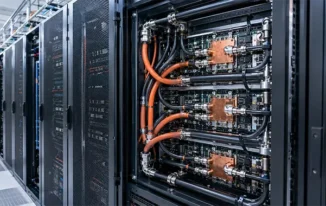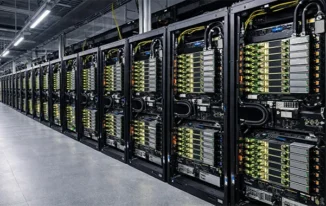


Training modern artificial intelligence models requires enormous computing resources. Large language models and advanced deep learning systems may contain billions of parameters and need thousands of GPU hours to complete training. A single server often cannot provide enough processing power, memory capacity, or network bandwidth to handle these workloads efficiently.
Distributed training clusters solve this challenge by connecting multiple computing nodes into a coordinated infrastructure. However, building a scalable cluster involves more than adding GPUs. Engineers must carefully design workload distribution, communication strategies, fault tolerance, and network topology to maintain performance during demanding training operations.
Understanding these architectural components is essential for organizations developing reliable AI infrastructure at enterprise scale.
Multi-Node Scaling Strategies for AI Training
Distributed training divides computational workloads across multiple GPUs and servers. The main challenge is ensuring that each processing unit contributes efficiently without creating excessive communication overhead.
Three important approaches are Data Parallelism, Tensor Parallelism, and Pipeline Parallelism.
Data Parallelism distributes copies of a model across multiple GPUs. Each GPU processes a different portion of the training dataset and calculates gradients independently. The gradients are then synchronized so that all model replicas maintain consistent parameters. Techniques such as All-Reduce help coordinate this communication.
Tensor Parallelism divides individual model operations across multiple GPUs. Instead of storing and processing an entire large tensor on one device, the system distributes its calculations across several processors. This approach is particularly useful when model layers exceed the memory capacity of individual GPUs.
Pipeline Parallelism divides a neural network into groups of layers, with different groups assigned to different GPUs or nodes. Micro-batches move through these stages, allowing multiple processing units to work simultaneously.
Modern frameworks such as DeepSpeed and Megatron-LM support distributed training techniques. Engineers can combine parallelism strategies to balance memory usage, communication costs, and processing efficiency.
Load Balancing Across Distributed Nodes
Effective load balancing ensures that computing resources remain productive throughout training. If some GPUs finish their assigned work earlier than others, they may remain idle while waiting for slower nodes.
This problem is commonly associated with the straggler effect. Differences in hardware performance, memory availability, network congestion, and workload complexity can create uneven execution times.
Infrastructure engineers can reduce these inefficiencies through workload profiling, optimized batch allocation, hardware-aware scheduling, and performance monitoring. Distributed training frameworks can also coordinate communication and computation to improve resource utilization.
Load balancing must consider both GPU capacity and network performance. Assigning workloads evenly by GPU count does not necessarily produce balanced execution when servers have different hardware configurations or communication paths.
Checkpointing and Fault Tolerance
Large-scale AI training can run continuously for days or weeks. During these operations, hardware failures, power interruptions, software errors, or network disruptions can interrupt progress.
Checkpointing is an important fault tolerance mechanism. It periodically saves the model’s training state so that the process can resume from a previous recovery point rather than restarting from the beginning.
A useful checkpoint may include model parameters, optimizer states, learning rate scheduler information, and random number generator states. Distributed training systems must coordinate these saves carefully to maintain consistency across nodes.
Engineers should also consider checkpoint frequency, storage throughput, recovery time, and available storage capacity. Saving checkpoints too frequently can interrupt training performance, while saving them too rarely increases the amount of work potentially lost after a failure.
Fault tolerance can be strengthened through redundant storage, automated recovery procedures, health monitoring, and failure detection mechanisms. Testing recovery processes before production training runs is especially important.
Network Topology for High-Performance Communication
Network design strongly influences distributed training performance. GPUs frequently exchange gradients, parameters, and intermediate tensors, making low-latency, high-bandwidth communication essential.
Fat-Tree and Clos network architectures are commonly used in scalable data center environments. These designs provide structured connectivity between servers and network switches, helping support communication across large clusters.
A well-designed network should provide sufficient bandwidth, predictable latency, and appropriate oversubscription ratios. High-speed technologies such as InfiniBand and RoCE can support Remote Direct Memory Access, reducing CPU overhead during data transfers.
Engineers must also evaluate network congestion, switch capacity, routing behavior, and communication patterns generated by their parallelism strategy. A topology that performs well for one workload may create bottlenecks for another.
Monitoring and Operational Reliability
Distributed training clusters require continuous monitoring. Administrators should track GPU utilization, memory consumption, network throughput, communication latency, node health, and training progress.
Automated alerts can help identify hardware failures and performance degradation before they cause significant disruption. Logs and metrics also make it easier to investigate unsuccessful training jobs and optimize infrastructure configurations.
Combining observability tools with workload orchestration systems creates a more manageable environment for large-scale AI development.
Resume
Architecting distributed training clusters requires careful coordination of computing resources, networking, and recovery mechanisms. Data, tensor, and pipeline parallelism allow large AI models to scale across multiple GPUs and servers, while load balancing helps maintain efficient resource utilization.
Checkpointing and fault tolerance protect long-running training operations, and optimized Fat-Tree or Clos network designs support communication across distributed nodes.
As AI models continue to grow, organizations will need infrastructure architectures that deliver not only processing power but also scalability, resilience, and predictable performance.