
Artificial intelligence is transforming data center infrastructure. Large language models, generative AI applications, and advanced machine learning systems require enormous computing resources to train models and process user requests. However, powerful GPUs alone cannot deliver maximum performance. They depend on fast communication networks, high-speed memory, and advanced cooling technologies to operate efficiently.
Modern AI data centers are therefore evolving beyond traditional server environments. High-speed interconnects reduce communication bottlenecks, High Bandwidth Memory (HBM) feeds processors with data, and liquid cooling systems manage the heat generated by increasingly powerful hardware. Understanding these technologies is essential for organizations building infrastructure capable of supporting demanding AI workloads.
High-Speed Interconnects: Keeping GPUs Connected
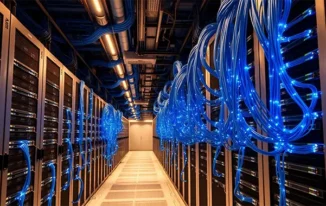
AI workloads often distribute calculations across multiple GPUs. During model training, these processors must exchange parameters, gradients, and intermediate results. If communication becomes too slow, powerful GPUs may spend valuable time waiting for data instead of performing calculations.
High-speed interconnect technologies help solve this problem.
NVLink is a high-bandwidth GPU interconnect technology developed by NVIDIA. It provides fast communication between supported GPUs and, in some systems, CPUs. This helps accelerate workloads that require frequent data exchange across multiple processors.
PCI Express (PCIe) Gen 5 and Gen 6 provide high-speed connections between CPUs, GPUs, storage devices, and other components. PCIe Gen 5 offers up to 32 GT/s per lane, while Gen 6 doubles the signaling rate to 64 GT/s per lane. Actual application throughput depends on lane configuration, encoding, and implementation.
For larger AI clusters, network technologies such as InfiniBand and RDMA over Converged Ethernet (RoCE) support communication between servers.
InfiniBand is widely used in high-performance computing environments because it provides low-latency communication and advanced networking capabilities. RoCE enables Remote Direct Memory Access over Ethernet, allowing systems to transfer data between memory locations with reduced CPU involvement.
Choosing between these technologies depends on workload requirements, network design, scalability, cost, and operational expertise.
High Bandwidth Memory: Why Data Movement Matters
GPU performance depends on more than processing speed. AI processors must continuously access model parameters, training datasets, and intermediate calculations. If memory cannot supply data quickly enough, the GPU may remain underutilized.
This is why High Bandwidth Memory is important.
HBM is a specialized memory technology that uses vertically stacked memory dies connected through high-density interconnects. Its architecture provides very high data-transfer bandwidth while placing memory close to the processor.
Think of a GPU as a factory with thousands of workers. Processing cores represent the workers, while memory supplies the raw materials. Even if the factory has excellent machinery, production slows when materials arrive too slowly. HBM helps deliver information at the speed required by demanding AI workloads.
Memory capacity matters too. Large AI models may require substantial memory to store parameters, activations, and other working data. When memory capacity is insufficient, systems may need to divide workloads across multiple GPUs or move data between different memory levels.
For infrastructure architects, evaluating memory bandwidth and capacity is therefore just as important as comparing theoretical GPU computing performance.
Thermal Cooling: The Shift Toward Liquid Cooling
High-performance AI servers generate significant heat. As GPU power consumption increases and server racks become denser, traditional air cooling can become less effective or more expensive to operate.
Conventional data centers use fans, airflow management, and computer room air conditioning systems to remove heat. These methods remain useful, but high-density AI infrastructure can create cooling challenges when many powerful processors operate inside a limited rack space.
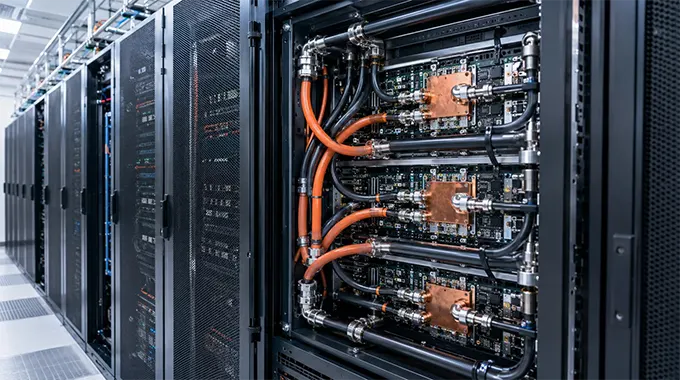
Direct-to-chip liquid cooling offers an alternative. In this approach, liquid circulates through cold plates attached to heat-generating components such as GPUs and CPUs. The coolant absorbs heat and transfers it to a facility cooling system.
Liquid cooling can remove heat more efficiently from targeted components than relying exclusively on airflow. It also supports higher-density rack configurations, depending on the facility design.
Another option is immersion cooling, where server components are submerged in specially designed dielectric fluid. Although it can provide effective heat management, it requires different hardware configurations and maintenance procedures.
The move toward liquid cooling is not simply about temperature control. It also affects power distribution, rack design, maintenance processes, and overall data center efficiency.
Balancing Performance Across the AI Infrastructure
The most effective AI data centers are designed as integrated systems. Fast GPUs cannot deliver their full potential if memory bandwidth is inadequate. High-bandwidth memory cannot solve slow communication between servers. Similarly, powerful processors cannot operate reliably without sufficient cooling.
Infrastructure teams should evaluate several factors together:
• GPU performance and memory capacity.
• Interconnect bandwidth and network latency.
• Storage throughput and data pipeline efficiency.
• Rack power density and electrical distribution.
• Cooling capacity and thermal management.
• Monitoring, redundancy, and hardware maintenance.
Performance monitoring is particularly important. Tracking GPU utilization, memory consumption, network congestion, and temperature helps administrators identify bottlenecks before they affect production workloads.
Conclusion : The Modern AI Data Center
Modern AI data centers depend on more than powerful processors. High-speed interconnects enable GPUs to communicate efficiently, HBM provides the memory bandwidth needed for demanding calculations, and liquid cooling helps manage the heat produced by dense computing systems.
Together, these technologies form the foundation of scalable AI infrastructure. As artificial intelligence workloads continue to expand, organizations that understand the relationship between computing, memory, networking, and thermal management will be better prepared to build efficient and reliable data centers.